
Ethereum Dancing on Two Fronts as Quantum Upgrade Advances and Treasury Leverage Bites

Ethereum builders need to improve the community to be quantum-ready by 2027, doubtlessly accelerating one among its largest safety overhauls. Nasdaq-listed BTCS has been promoting ETH beneath its buy worth to handle $64.1 million in excellent Aave debt.
Both tales carry important implications for Ethereum’s subsequent progress section. One may reshape its technical roadmap, whereas the opposite underscores the monetary dangers of treating ETH as collateral for aggressive DeFi methods.
Ethereum Quantum Upgrade Targets 2027 as AI Accelerates Security Concerns
Ethereum analysis group Ethlabs desires builders to carry ahead the community’s post-quantum safety timeline to 2027. Its proposal, referred to as pqai27, argues that advances in synthetic intelligence are accelerating the dangers surrounding quantum computing and current cryptographic methods.
The Ethereum quantum improve would purpose to guard accounts, transactions, and community consensus in opposition to future quantum assaults. Ethlabs additionally desires Ethereum to grow to be extra proof against AI-powered assaults that might expose vulnerabilities in its software program.
The proposal comes two years forward of the Ethereum Foundation’s current December 2029 goal for full post-quantum readiness. Google has individually focused 2029 for its personal post-quantum transition, whereas the U.S. authorities has moved its quantum safety deadline from 2035 to 2030. Ethlabs desires two milestones achieved throughout 2027.
The first, referred to as pqai-ready, would set up post-quantum consensus and give customers a pathway towards quantum-resistant accounts. The second, pqai-scaled, would carry quantum-resistant transactions and information availability to full community capability.
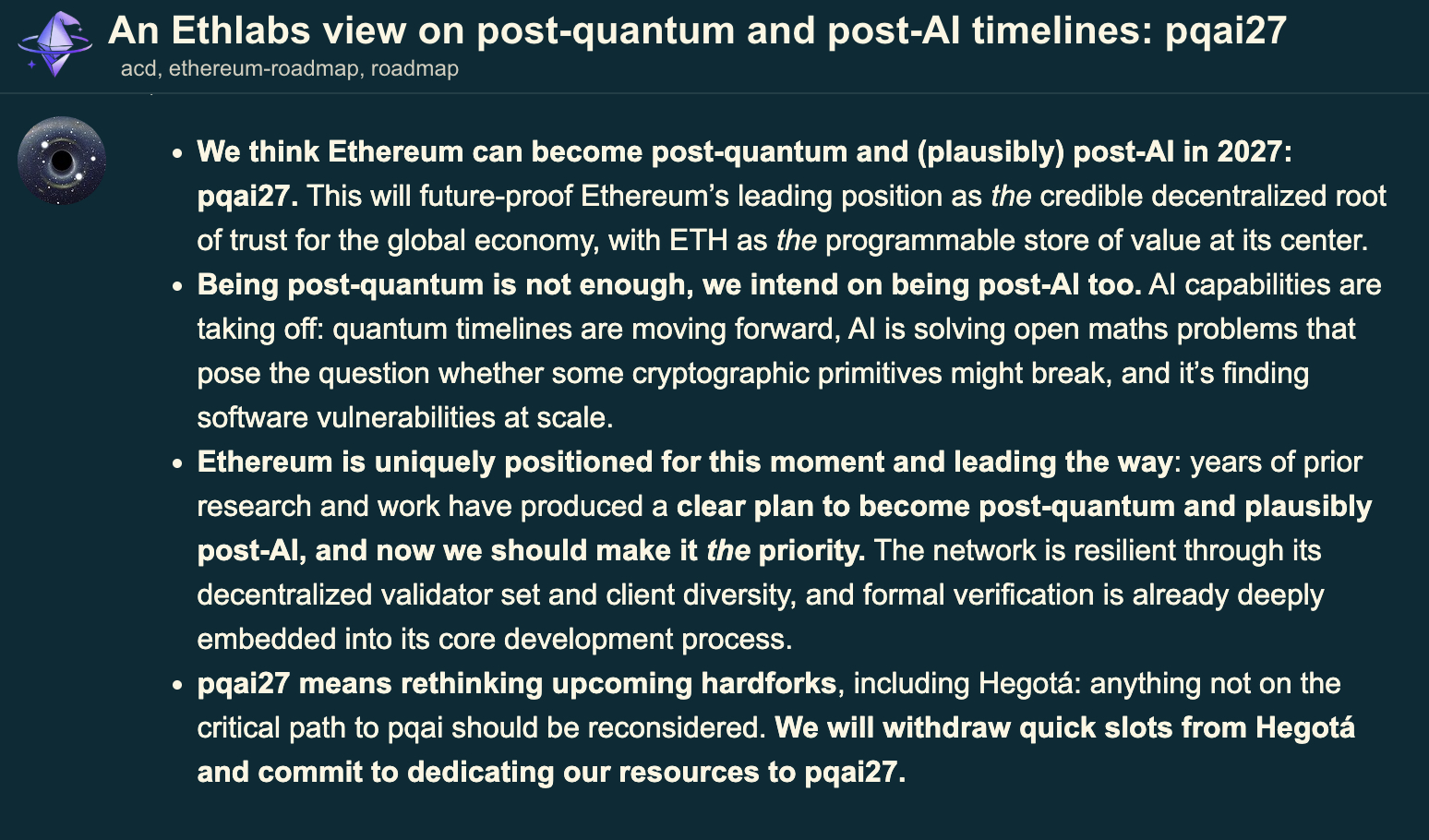
Getting there requires builders to rethink upcoming community upgrades. Ethlabs has already supplied to withdraw its Quick Slots proposal from the deliberate Hegotá exhausting fork to redirect sources towards quantum safety.
Quick Slots would have lowered Ethereum’s block manufacturing interval from 12 seconds to 10 seconds. The group now desires to prioritize safety and revisit sooner block manufacturing in 2028.
Frame Transactions, in the meantime, stay central to the proposed transition. They would enable accounts to make use of extra versatile authentication strategies, together with signatures designed to withstand quantum assaults.
The Ethereum quantum improve may additionally change transaction economics, as Quantum-resistant signatures usually require extra information, doubtlessly rising transaction prices and creating further calls for on pockets suppliers.
Ethlabs is successfully asking Ethereum builders to prioritize long-term safety over sure efficiency enhancements. This is a shift in priorities as the community competes for institutional adoption and real-world monetary exercise.
Discover: The Best Token Presales
BTCS Sells ETH Below Cost as $64M Aave Debt Exposes Treasury Risks
While Ethereum builders focus on future safety, company ETH holders face a extra fast drawback: leverage. BTCS disclosed in its newest quarterly submitting that it offered ETH beneath its authentic buy worth to handle collateral ranges and repay DeFi borrowings.
As of as we speak, the Nasdaq-listed firm had $64.1 million in excellent Aave debt, together with accrued curiosity. It backed that borrowing with 46,676 ETH valued at $99.3 million. That left its collateral price 155% of excellent debt. Based on these figures, the place carried an estimated liquidation threshold close to $1,717 per ETH.
BTCS additionally reported $30.6 million in realized losses on digital asset transactions throughout the first 9 months of 2026. The firm attributed the rise primarily to ETH gross sales used to handle collateral and repay DeFi borrowings, alongside accounting losses from depositing ETH into liquidity swimming pools.
The firm didn’t disclose how a lot ETH it offered beneath value or how a lot of its realized losses got here instantly from these gross sales. But its borrowing historical past reveals the size of the technique. Between January 2025 and November 11, 2026, BTCS borrowed $152.4 million in stablecoins by means of Aave, primarily USDT and GHO. It repaid $89.4 million over the identical interval.
The firm mentioned no full or partial liquidation had occurred as of November 11.
Nevertheless, the place illustrates the stress that leveraged company treasury methods can face when ETH costs fall. Borrowing in opposition to ETH creates further capital alternatives, however declining collateral values can pressure firms to promote holdings or repay debt.
Discover: The Crypto Presales This Q4 2026
The put up Ethereum Dancing on Two Fronts as Quantum Upgrade Advances and Treasury Leverage Bites appeared first on Cryptonews.


