
Western Europe’s Crypto Economy Reaches $2.08T as Stablecoin Holdings Surge 131%
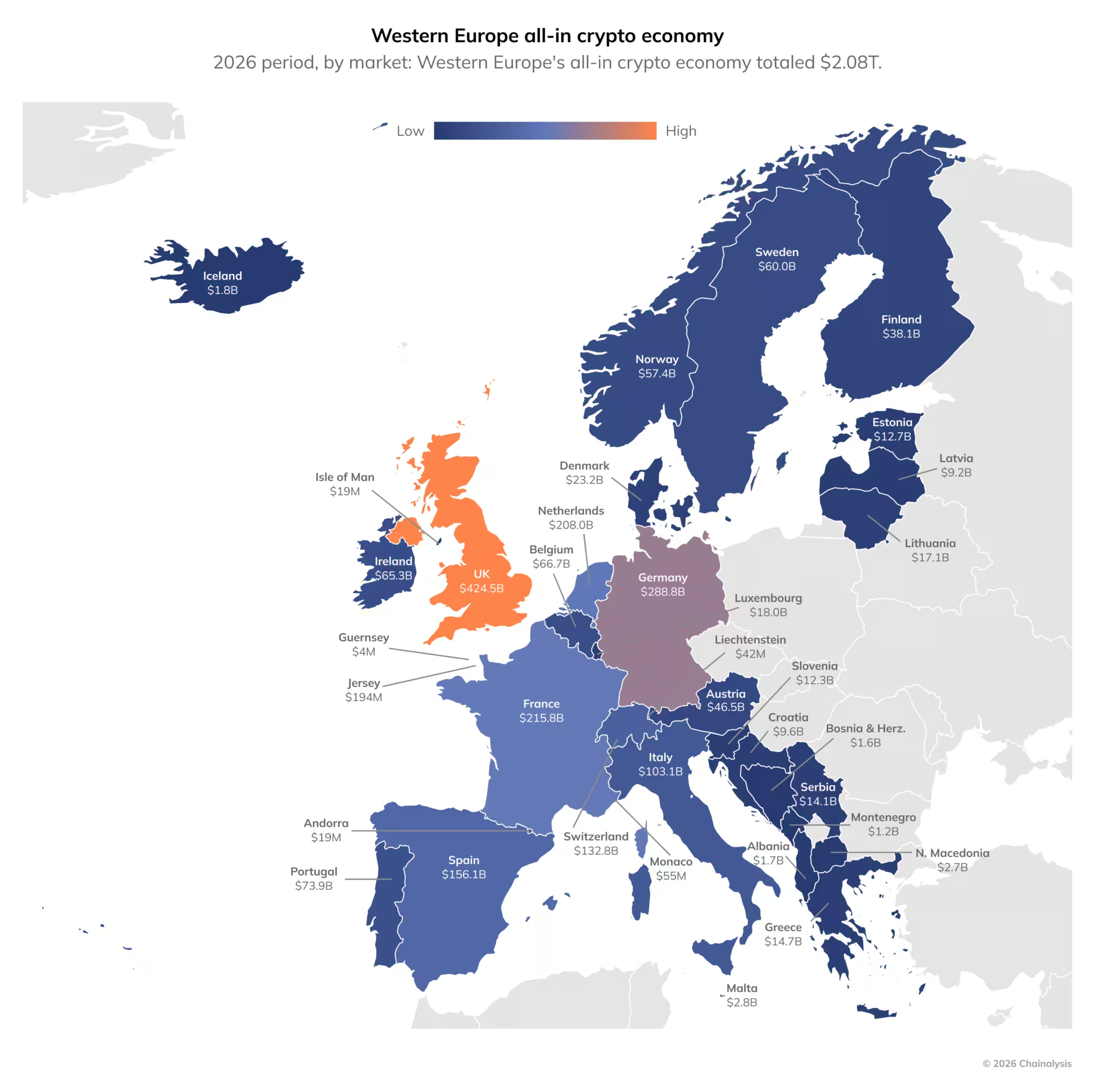
Western Europe’s crypto financial system continued to broaden regardless of a broader world market downturn, reaching $2.08 trillion in annual transaction exercise as stablecoin adoption accelerated throughout the area.
A report published by blockchain analytics firm Chainalysis on November 9 discovered that crypto exercise elevated 1.2% between July 2025 and June 2026. This made Western Europe the world’s second-largest regional crypto financial system and positioned it amongst solely three areas to file constructive progress in the course of the interval.
Stablecoins have been one of many strongest areas of growth. Holdings in private wallets throughout Western Europe climbed 131%, considerably outperforming the worldwide progress price of 52%. However, the figures additionally revealed contrasting developments amongst main markets, with the UK retaining its place as Europe’s largest crypto financial system regardless of an annual decline in general exercise.
UK Remains Western Europe’s Largest Crypto Market Despite Contraction
The UK accounted for the biggest share of Western Europe’s cryptocurrency exercise, recording roughly $424.5 billion in transaction worth in the course of the reporting interval. Nevertheless, exercise declined 8% 12 months over 12 months, with lowered decentralized trade buying and selling contributing to the slowdown.
Germany ranked second with $288.8 billion, adopted by France at $215.8 billion and the Netherlands at $207.8 billion. Spain and Switzerland recorded $156.1 billion and $132.8 billion, respectively.
Together, these six nations represented roughly two-thirds of the area’s complete crypto financial system, highlighting how closely exercise stays concentrated in Western Europe’s largest monetary markets.
Stablecoin Holdings Outpace Global Growth
Stablecoins emerged as one of the important drivers of Western Europe’s crypto growth. Personal-wallet holdings elevated by 131% over the 12-month reporting interval, in contrast with 52% progress worldwide.
The area’s share of world stablecoin balances consequently elevated from 3.4% to five.1%. Austria and France recorded significantly sturdy positive aspects, whereas the broader pattern means that stablecoins have gotten extra essential to how Europeans retailer and transfer digital belongings.
Regulatory developments are additionally shaping the market. The European Union’s Markets in Crypto-Assets Regulation (MiCA) has established a typical framework for crypto-asset issuers and repair suppliers, creating clearer necessities for companies working throughout the bloc.
UK Domestic Stablecoin Transfers Climb to $2.09 Billion
Despite the contraction in its general crypto financial system, the UK recorded a considerable improve in home stablecoin exercise.
Transfers between UK-based wallets reached $2.09 billion in the course of the reporting interval, in contrast with simply $109 million within the earlier 12 months. This represented roughly 60% of Western Europe’s complete home stablecoin switch worth, exceeding the mixed $1.41 billion recorded throughout the remainder of the area.
The findings recommend that stablecoins are more and more getting used for home transactions moderately than completely for worldwide transfers. In the UK, home stablecoin transfers have been 1.32 occasions the worth of the cross-border activity measured by Chainalysis. The remainder of Western Europe displayed the alternative sample, with cross-border transfers considerably outweighing home exercise.
Retail pockets conduct additionally mirrored rising curiosity in stablecoins. Approximately 1.03% of eligible UK retail wallets transformed at the least 80% of their cryptocurrency holdings into stablecoins, up from 0.66% a 12 months earlier.
French Investors Increase Stablecoin Self-Custody
France recorded one other notable growth, with stablecoin balances held in private wallets rising by 192% in the course of the reporting interval.
The variety of French private wallets holding stablecoins rose from 3,577 in June 2025 to 12,255 in June 2026. Stablecoins additionally accounted for 54.2% of withdrawals from centralized exchanges by the tip of the interval, the best proportion among the many main Western European markets included within the evaluation.
The pattern unfolded amid fiscal strain and political uncertainty in France. Chainalysis famous that the expansion in self-custody coincided with durations of stress within the nation’s bond market, though the info doesn’t set up a direct causal relationship.
The improve means that extra French crypto customers are selecting to maneuver stablecoins away from centralized platforms and maintain them in private wallets. This offers customers better direct management over their digital belongings whereas reflecting a broader shift in how stablecoins are used throughout the area.
MiCA and Stablecoins Could Shape Europe’s Next Crypto Growth Phase
Western Europe’s $2.08 trillion crypto financial system demonstrates that the area has maintained progress even as world market circumstances weakened. However, the report exhibits that this growth shouldn’t be uniform.
The UK stays the biggest market by transaction worth, however its annual contraction contrasts with the expansion recorded in different components of the area. Meanwhile, stablecoin holdings, home transfers, and self-custody have gotten more and more essential indicators of how European customers work together with digital belongings.
MiCA’s regulatory framework might additional affect this growth by offering clearer necessities for companies and inspiring conventional monetary establishments to discover blockchain-based providers. At the identical time, the growth of euro-denominated stablecoins could strengthen the connection between standard finance and digital asset markets.
Whether these developments translate into sustained progress will rely upon regulatory implementation, institutional participation, and continued demand for stablecoin-based monetary providers.
Do you assume stablecoins will turn into a mainstream cost technique throughout Western Europe as adoption continues to extend?
Could MiCA assist Europe turn into a number one marketplace for regulated digital belongings and tokenized monetary merchandise?


