
Vitalik Buterin Is Designing Chips: Could Ethereum Become a Hardware Company and Overtake Nvidia?

Vitalik Buterin is taking Ethereum’s decentralization philosophy right down to the silicon stage. The Ethereum co-founder revealed a deep dive into open-source chip design right this moment, masking the whole lot from transistor structure and manufacturing to {hardware} safety. His central argument? It may have implications far past Ethereum, and computing {hardware} shouldn’t stay a proprietary black field.
Could Ethereum finally transfer past blockchain infrastructure and construct its personal {hardware} ecosystem? Vitalik’s newest exploration makes that prospect an fascinating thought experiment, notably as Nvidia dominates the computing business.
Vitalik Wants to Bring Decentralization Down to Silicon

Vitalik’s argument begins with a acquainted drawback in crypto: belief. Software may be audited, code may be revealed, and blockchain transactions may be independently verified. Hardware, nevertheless, stays significantly more durable to examine.
A chip can include hidden vulnerabilities or malicious modifications that customers can not simply detect. Even a safe pockets software can not assure security if the {hardware} beneath it has been compromised. This has occurred lately with Ledger, and Ledger isn’t the one one, with Trezor and different {hardware} wallets being lately compromised.
“Not your silicon, not your keys.” – Vitalik put the issue bluntly.
The phrase extends crypto’s self-custody mantra into the bodily computing layer. Owning non-public keys won’t imply a lot if customers can not belief the {hardware} dealing with them.
This is why Vitalik argues that “the {hardware} layer should be open for participation and tinkering too.” He needs {hardware} designs to change into accessible to builders, researchers, and unbiased auditors, permitting them to look at and modify parts slightly than blindly trusting producers.
This may finally create alternatives for Ethereum {hardware} centered on safety, cryptographic computing, and decentralized infrastructure. Ethereum validators, {hardware} wallets, and zero-knowledge proof programs all rely on computing parts that customers must belief.
Discover: The Best Token Presales
Could Ethereum Become Nvidia’s Challenger?
Nvidia constructed its dominance by turning GPUs into the spine of synthetic intelligence. Its {hardware}, software program ecosystem, and CUDA platform have made competitors more and more tough.
But Vitalik’s imaginative and prescient shows a totally different method. Instead of chasing the quickest processors, Ethereum {hardware} may prioritize openness, verifiability, and safety.
Vitalik acknowledges that open-source {hardware} faces efficiency limitations. Advanced chip manufacturing stays costly and tightly managed, leaving open designs behind the business’s most refined industrial processors.
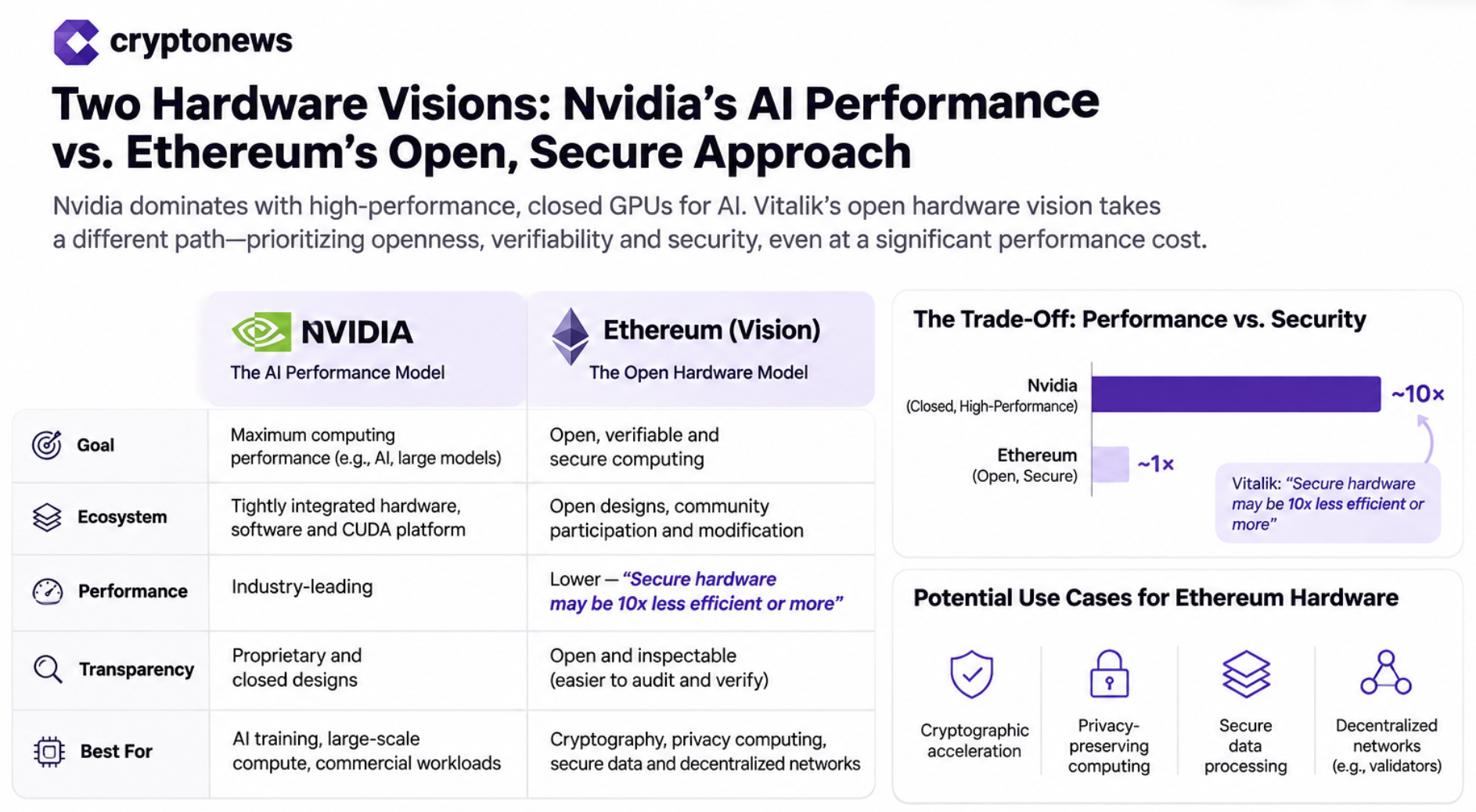
Yet that trade-off won’t matter for each workload. Vitalik writes that “Secure {hardware} could also be 10x much less environment friendly or extra” whereas nonetheless being ample for a lot of computing wants. That’s a placing distinction to an business obsessive about squeezing extra efficiency from more and more costly chips.
Specialized silicon designed for cryptographic operations, privacy-preserving computing, safe knowledge processing, or decentralized networks may benefit from open designs. Developers may modify the structure, researchers may examine the circuitry, and producers may compete to provide chips from publicly accessible specs.
Ethereum already has an in depth developer group experimenting with cryptography and distributed computing. Extending that tradition into silicon may give the ecosystem a foothold in {hardware} with out instantly difficult Nvidia’s AI infrastructure.
The ambition could possibly be much less about constructing one other GPU large and extra about creating a competing {hardware} philosophy.
Discover: The Crypto Presales This Q4 2026
Ethereum Hardware: A Bigger Bet Than Crypto
Vitalik’s argument reaches past blockchain. He sees open {hardware} as a broader computing motion, the place customers can examine, confirm, and modify the machines they rely on.
That may finally prolong into private computer systems, servers, IoT units, and safe computing infrastructure. Hardware designed round transparency may change into priceless as AI, monetary providers, and delicate private knowledge transfer into more and more highly effective machines.
Nvidia’s dominance isn’t going to vanish in a single day. But Ethereum has by no means wanted to observe the standard expertise business’s playbook.
Its biggest energy has been constructing infrastructure round open participation slightly than centralized possession. If that philosophy finally reaches the silicon powering fashionable computing, Ethereum may discover itself competing in an business few would have anticipated.
Vitalik’s newest deep dive into chip design raises a query: What occurs when crypto’s decentralization motion stops at software program and begins constructing the {hardware}, too?
Gain Access to New Bitcoin Layer 2 Early Before the Presale Window Ends In a Few Hours
The publish Vitalik Buterin Is Designing Chips: Could Ethereum Become a Hardware Company and Overtake Nvidia? appeared first on Cryptonews.

