
Bitcoin Is Busier Than Ever, but Bitcoin Mining Isn’t Getting Paid More

Bitcoin is processing extra transactions than ever earlier than on an annual foundation, but the rising exercise is doing little to enhance one of many community’s most necessary income streams, mining and transaction charges.
The Bitcoin community averaged 578,000 transactions per day from January 1 by means of September 28, 2026, surpassing its earlier annual report of roughly 525,000 transactions in 2024. Yet the common transaction price has fallen sharply, leaving miners more and more depending on newly issued BTC moderately than funds from customers.
Firsthand reported that charges accounted for simply 0.6% of miners’ complete earnings throughout the interval it examined. This hole raises a much bigger query about Bitcoin’s economics: if community utilization continues to broaden, why isn’t that exercise producing extra earnings for the miners securing the blockchain?
Discover: The Crypto Presales This Q4 2026
Bitcoin Transaction Fees Fall Despite Record Network Activity
Recent blockchain information highlights the hole between transaction quantity and miner income. Bitcoin averaged 701,660 confirmed transactions per day throughout the 30 days by means of October 14, up roughly 49% from 469,638 transactions a day throughout the comparable interval a 12 months earlier. However, the common variety of lively addresses declined 12%, from 729,972 to 644,263.
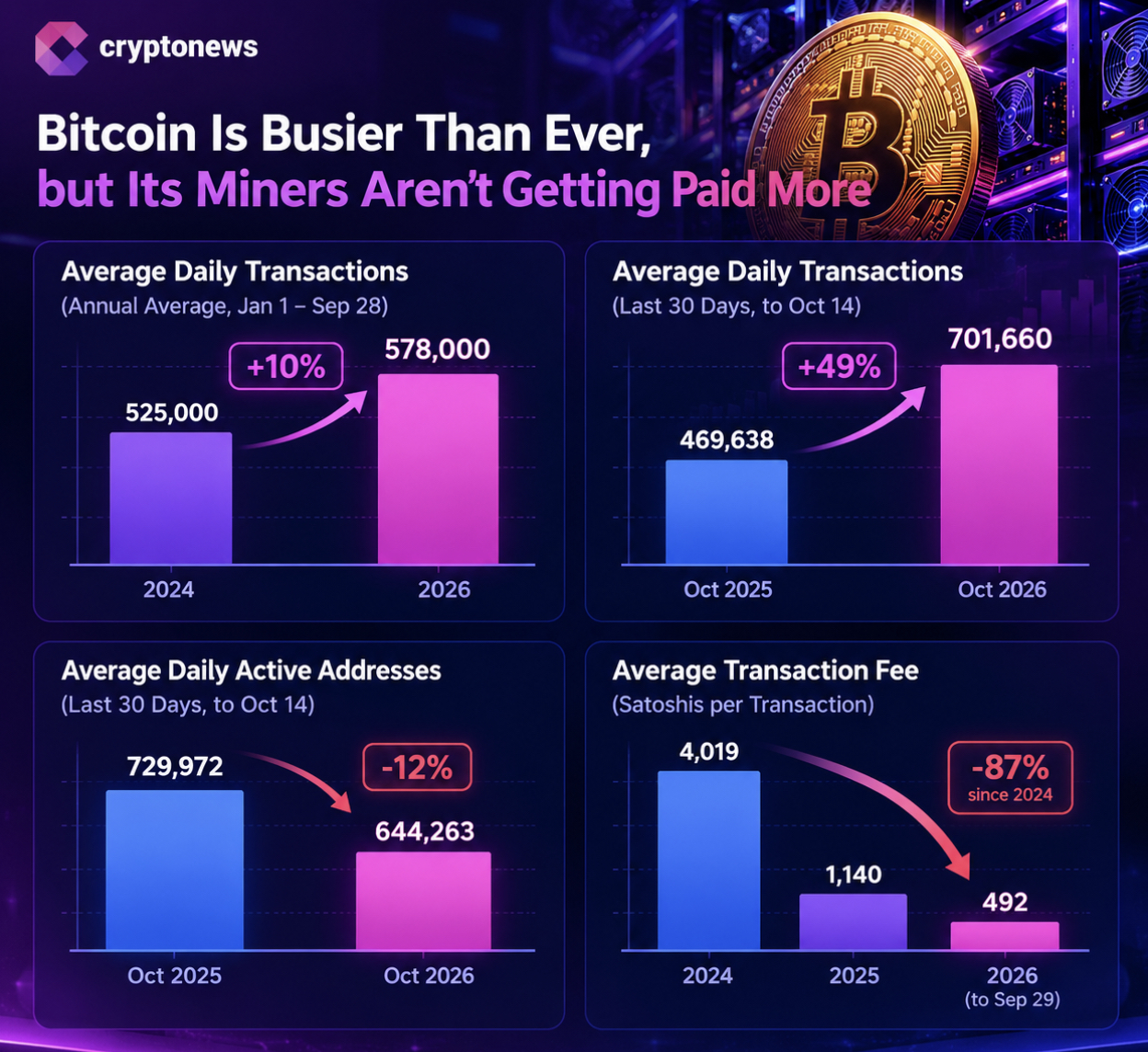
That progress has not translated into stronger Bitcoin transaction charges.
September has its common transaction paid roughly 492 satoshis in charges throughout 2026 by means of September 29, in contrast with 1,140 satoshis in 2025 and 4,019 satoshis in 2024. At the present Bitcoin worth, the everyday price amounted to $0.41.
The figures recommend that increased transaction counts alone don’t assure stronger demand for block area. Fees rely upon competitors to have transactions confirmed, not merely on what number of transactions the community processes.
Bitcoin miners obtain income from two major sources: the block subsidy, which awards newly issued BTC, and transaction charges collected from confirmed transactions.
The subsidy presently stands at 3.125 BTC per block following the April 2024 halving. It will fall to 1.5625 BTC after the following halving, anticipated in 2028, lowering the quantity of newly issued Bitcoin miners obtain for producing every block.
The 30 days by means of October 14 discovered that miners collected roughly 88.6 BTC in transaction charges, in contrast with 13,884 BTC in newly issued cash. That imbalance makes Bitcoin transaction charges an necessary long-term consideration for community safety. If subsidy income declines over successive halvings, charges would wish to contribute extra meaningfully to miners’ earnings, all else being equal, to assist offset the discount.
However, the information doesn’t imply Bitcoin mining is presently unprofitable. Miners additionally earn income from the market worth of their block rewards, and their profitability is dependent upon electrical energy prices, {hardware} effectivity, financing, and different working bills.
Mining Pool Concentration and Bitcoin Economy
The income query comes as Bitcoin mining faces one other structural change.
Binance introduced that it might discontinue Binance Pool and associated companies on November 10, 2026. The closure would require taking part miners to redirect their computing energy to different swimming pools in the event that they need to proceed mining by means of a pooled service.
Foundry USA, AntPool and F2Pool collectively accounted for about 64% of Bitcoin’s community hashrate. Binance’s departure may additional focus block manufacturing if miners migrate towards the most important remaining swimming pools, though the end result will rely upon the place that computing energy finally strikes.
Bitcoin’s rising transaction rely demonstrates that community exercise stays substantial, but exercise alone is an incomplete measure of financial demand. Bitcoin could also be getting busier, but its long-term mining economics will rely upon what customers are prepared to pay.
Discover: The Best Token Presales
The publish Bitcoin Is Busier Than Ever, but Bitcoin Mining Isn’t Getting Paid More appeared first on Cryptonews.

